Noticing when a member has quietly stopped coming
By Emmanuel Akyeam, Founder of Fold
In short
To notice when a member has quietly stopped coming, record who attended each service by name, not just a head count, and compare each member against their own pattern rather than the congregation's average. Someone who came almost every week for six months and has missed the last six weeks is worth a phone call; someone who has always come twice a year is not drifting. Judge attendance against the services actually held, and expect a few weeks of recording before any pattern appears.
Almost nobody leaves a church by telling the pastor. They come fortnightly instead of weekly, then monthly, then at Christmas, then not at all. Six months later somebody asks after them and nobody is quite sure when they were last seen.
By that point a visit is a difficult conversation. Four months earlier it would have been a phone call. Fold's insights page exists to make it a phone call.
Why a head count cannot tell you
Most churches record attendance as a number: so many men, so many women. It is quick, it is what the return asks for, and it is genuinely useful for spotting whether the congregation is growing.
But a total cannot tell you who is missing. A church of 300 that loses eight regular members and gains eight visitors looks identical on paper, while eight families have quietly drifted away.
The signal is a change, not a level
The instinct is to look for low attendance. That is the wrong measure, and it produces a list of people who were never very involved in the first place. Someone who has always come twice a year is not drifting. They are simply someone who comes twice a year.
What matters is a change against a person's own pattern. Someone who came almost every week for six months and has not been seen for six weeks is a different case entirely, and that is the one worth a phone call.
Compare each member against their own history, not against the congregation's average.
| Member | Their pattern | Recently | Worth a phone call? |
|---|---|---|---|
| Always comes twice a year | Twice a year | Twice a year | No, nothing has changed |
| Came almost every week for six months | Weekly | Not seen for six weeks | Yes |
| Missed the two Sundays the church did not meet | Weekly | Present at every service held | No, judge against services held |
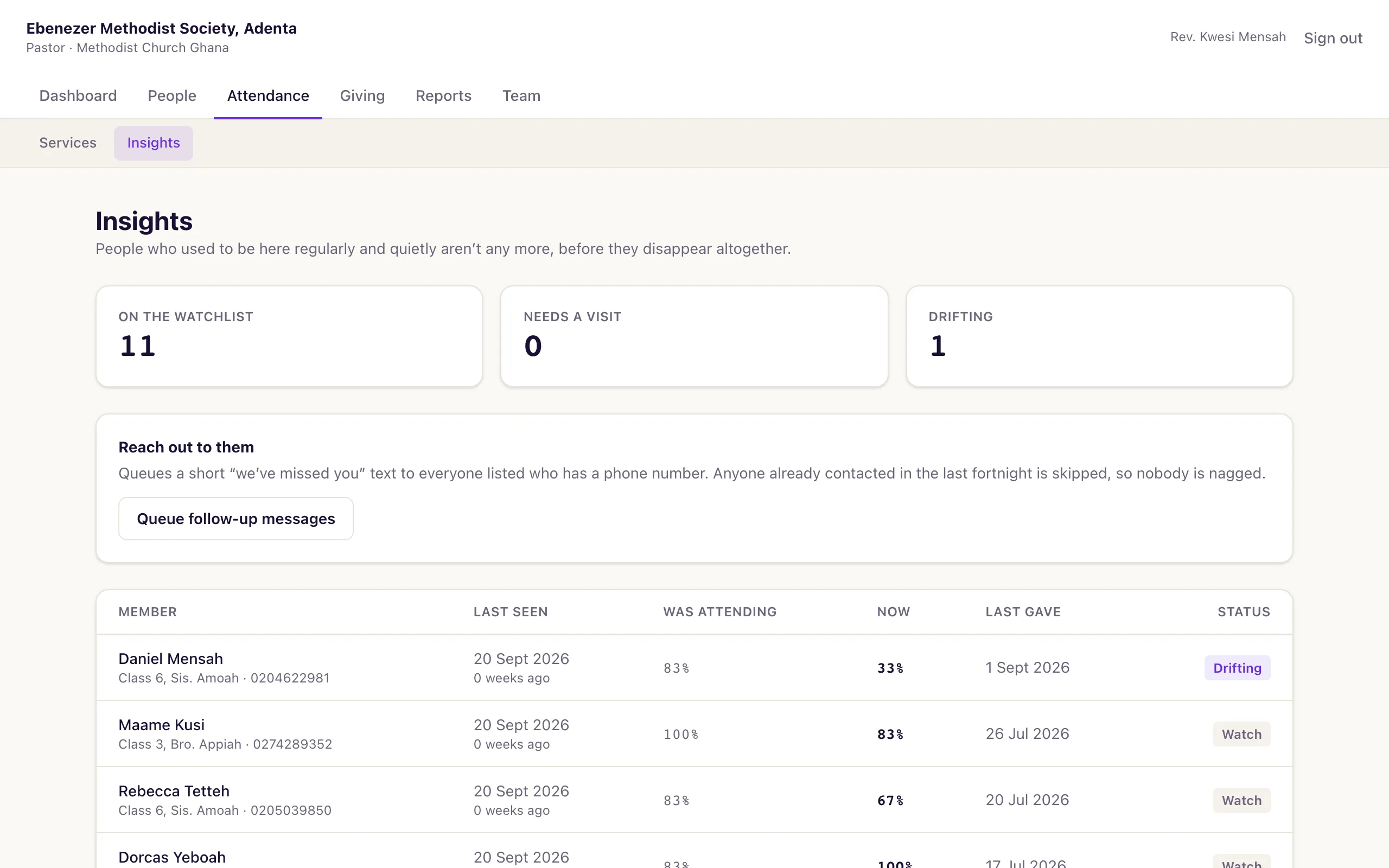
Measure against services actually held
One detail that is easy to get wrong: attendance has to be judged against the services the church actually held, not against the number of weeks. If your church did not meet for two Sundays, everybody's attendance looks worse, and a naive calculation will hand the pastor a list of forty people who have done nothing unusual.
What it costs to start
The only new work is naming who attended, rather than only counting. On paper that is a slow job. Done on a phone, with a searchable list and one save at the end, it takes a couple of minutes at the back of the service, and it need not be perfect. Even the regulars alone will tell you most of what you need.
And there is no shortcut on time. You cannot know who is drifting until there is a pattern to drift from, which means a few weeks of recording before anything useful appears. That is worth saying plainly, because software that promises otherwise is guessing.
Part of Running a church in Ghana: the complete guide, which covers the register, attendance, giving, the statistical return and more, each with free templates.