Keeping the church register: a guide for church secretaries
By Emmanuel Akyeam, Founder of Fold
In short
A church register needs six fields filled in for every member: full name, a phone number they answer, date of birth, class or group, status (active, lapsed, transferred out or deceased) and the date they joined or were baptised. Status matters most, because the return counts members now, not every name ever written down, so change a status when something happens and never delete a name. Under Ghana's Data Protection Act, 2012 (Act 843) a church keeping a register is a data controller, so collect only what you need, keep it where only the right people can reach it, and be able to show or delete a member's record on request.
Ghana's 2021 census counted 71.3 percent of the country as Christian, roughly 22 million people, and nearly every one of them is on a register somewhere: a book in a vestry, a spreadsheet on a secretary's laptop, or a system somebody set up and left. The register is the church's memory. The return, the birthday list, the count of who has stopped coming and the letter of transfer all come out of it, and every one of those is only as good as the register underneath. This is how to keep one properly, written for the person who has just been handed it.
| Pentecostal or charismatic | 31.6% |
|---|---|
| Other Protestant, including Methodist, Presbyterian and Anglican | 17.4% |
| Other Christian | 12.3% |
| Catholic | 10% |
Source: Ghana Statistical Service, 2021 Population and Housing Census, General Report Volume 3C. Together these make the 71.3 percent who are Christian.
Six fields, always filled in
A register with twelve fields half filled is worse than one with six always filled, because a blank you cannot trust poisons the fields around it. These six earn their place:
- Full name as they would write it, family name last, so the register sorts and searches.
- A phone number they actually answer, in full: 024 400 0000, not the last six digits somebody remembers. With 26.7 million active mobile money accounts in Ghana, a phone number is also how most members will give.
- Date of birth, or at least month and day. This is what makes a birthday text possible, and a birthday text from the church is worth more than it costs.
- Class, fellowship, cell or society, in your denomination's own word. Membership is counted by group on every return.
- Status: active, lapsed, transferred out or deceased. The most important field, and the one most registers lack.
- The date they joined, were received or were baptised. Membership is usually defined by one of these, and a dispute is settled by it.
| Field | Write it as | What it makes possible |
|---|---|---|
| Full name | As they would write it, family name last | A register that sorts and searches |
| Phone number | In full, 024 400 0000 | Reaching the member, and mobile money giving |
| Date of birth | At least month and day | A birthday text from the church |
| Class or group | In your denomination's own word | Membership by group on every return |
| Status | Active, lapsed, transferred out or deceased | A count of members now, not of every name |
| Date joined or baptised | A full date | Settling who is a member |
Why status matters most
A book accumulates names for years and never loses one. That is fine as a history and useless as a register, because the return wants the people who are members now. The difference between a book with 400 names and a church with 212 active members is the status field, and without it every quarter's count starts from scratch. Mark every name once, then change a status when something happens: a transfer letter goes out, a funeral is held, a class leader confirms somebody has not been seen for a year. Never delete a name. A member who lapses and returns should find her record waiting, baptism date and all.
Transfers, in both directions
When a member moves within the denomination, the sending church issues a letter of transfer and marks the record transferred out; the receiving church marks a transfer in. Both should happen, and the circuit checks they balance. The commonest failure is a member attending her new church for a year while still counted at the old one.
What the Data Protection Act asks of a church
Under the Data Protection Act, 2012 (Act 843), a church that keeps a register is a data controller, and religious belief is special personal data. What that means for a church using Fold is written up separately; three consequences follow for any church, none onerous:
- Collect what you need and say why. A member who gave her number for the register should not find it on a fundraising list she never agreed to.
- Keep it where only the right people can reach it. A register on a laptop with no password, or forwarded round a WhatsApp group, is exactly what the Act is about.
- Show it or delete it on request. A member who leaves can ask what you hold and ask you to remove it, and you should be able to do both.
The Data Protection Commission expects organisations holding personal data to register with it. Whether your church has is worth raising at the next council meeting.
Book, spreadsheet or software
A book is cheap, needs no electricity and everyone understands it. Only one person can use it at a time, it cannot be counted without reading every page, and one fire ends the church's memory. If yours is a book, keep a second copy elsewhere and update it quarterly.
A spreadsheet is searchable, countable and free, and works while one person keeps it. It stops working the first time it is emailed and two copies exist. Keep it in Google Sheets rather than on one laptop, and give the pastor access.
Software gives several people one record, counts itself, and produces the return and the birthday list without anyone compiling them, for a quarterly subscription and an evening moving the register across. Choose one that reads your spreadsheet in, lets you export it out, and understands your denomination rather than treating a society as a small group.
| Book | Spreadsheet | Software | |
|---|---|---|---|
| Cost | Cheap | Free | A quarterly subscription |
| Who can use it | One person at a time | One person, until it is emailed and two copies exist | Several people, one record |
| Counting for the return | Read every page | Searchable and countable | Counts itself and produces the return |
| Main risk | One fire ends the church's memory | Two copies that disagree | Choosing one you cannot export from |
| Do this | Keep a second copy elsewhere, updated quarterly | Keep it in Google Sheets and give the pastor access | Choose one that imports your spreadsheet and exports it back |
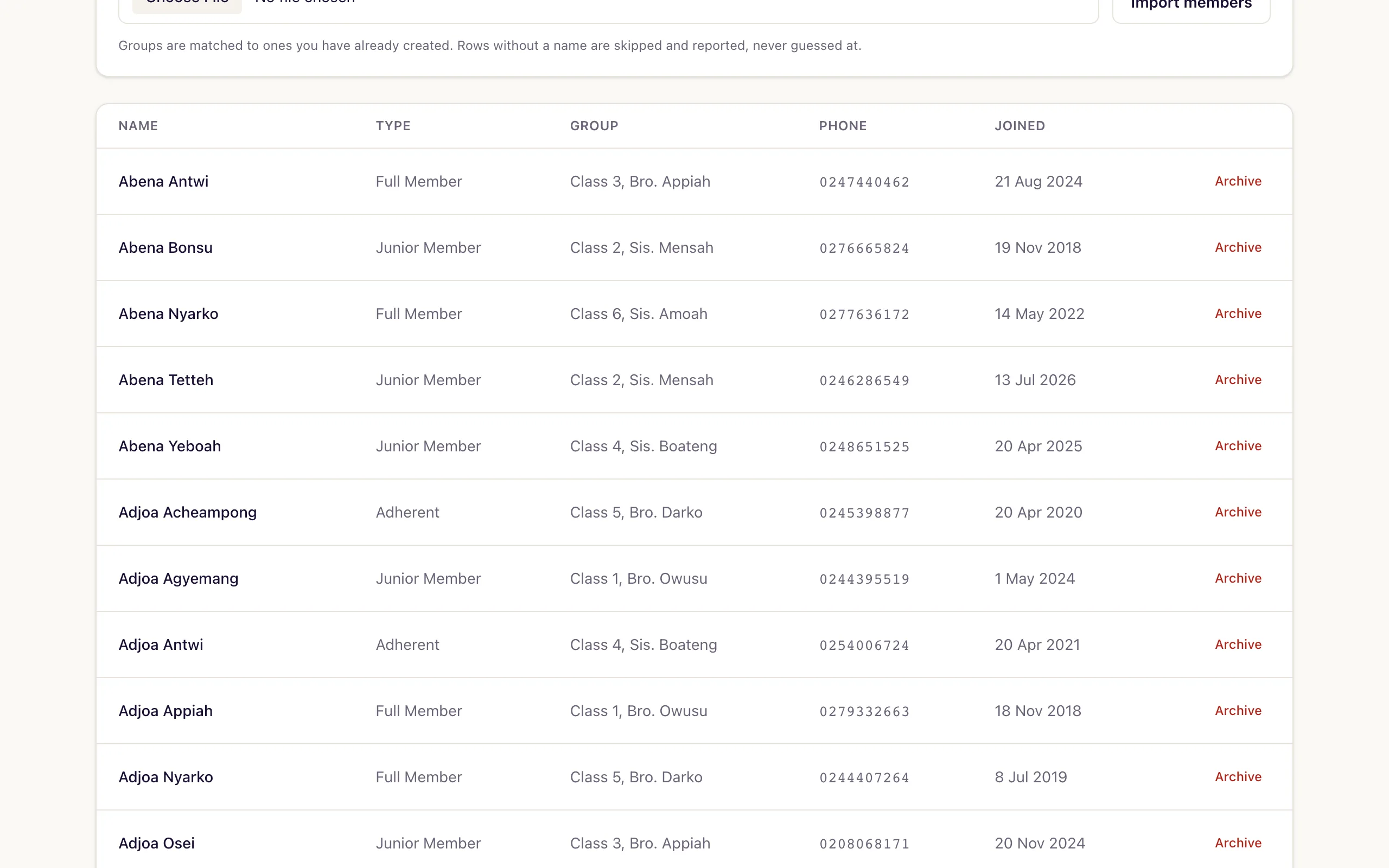
Moving from a book
- Do not type the whole book. Start with last Sunday's congregation, then the Sunday before. Active members first; the rest over a month. There is a longer piece on moving from a book.
- Decide the six fields before you start. Adding a column halfway means going back over every row.
- Set a status for every name as you go. This is the one chance to do it cleanly.
- Give each class leader their own list to check. They know who has moved and who has died.
- Keep the book. A baptism date from 1987 is still a baptism date.
Questions people ask
- What should a church membership register contain?
- At minimum: full name, phone number, date of birth, the class or group, status (active, lapsed, transferred or deceased), and the date they joined or were baptised. Address and next of kin are useful if the church keeps them current.
- How do you keep church records safe?
- Keep a second copy away from the church building, limit access to the pastor, the secretary and named officers, and never forward the whole register through a messaging group. Digital records need a password and a backup on a different device.
- Does the Data Protection Act apply to churches in Ghana?
- Yes. A church keeping a register is a data controller under Act 843, and religious belief is special personal data. Collect only what you need, keep it secure, and be able to show or delete a member's record on request.
- Spreadsheet or software for church members?
- A spreadsheet works while one person keeps it. Software makes sense once several people record attendance, giving and members, because it keeps one record and produces the return without compiling. Choose one that imports your spreadsheet and exports it back.
Sources
- 1.Ghana Statistical Service, 2021 Population and Housing Census, religious affiliation
- 2.Ghana Statistical Service, 2021 Population and Housing Census, General Report Volume 3C, Christian traditions as a share of the population, via Wikipedia
- 3.Bank of Ghana via MyJoyOnline, active mobile money accounts reached 26.7 million in 2025
- 4.Data Protection Act, 2012 (Act 843), full text as published by the National Communications Authority
Part of Running a church in Ghana: the complete guide, which covers the register, attendance, giving, the statistical return and more, each with free templates.