How to prepare a church statistical return, step by step
By Emmanuel Akyeam, Founder of Fold
In short
A church statistical return reports five things for the quarter: membership by class, average attendance per service, baptisms, confirmations, marriages and deaths, transfers in and out, and income including mobile money. The first four come from the register and the fifth from the offering book, so the work is agreeing those records, not the arithmetic. Count only active members, average attendance over the services actually held, and agree the income total, mobile money included, with the treasurer before writing it down.
The Methodist Church Ghana alone has 4,934 societies in 337 circuits, and each society sends its circuit a statistical return every quarter. Add the Presbyterian congregations reporting to districts, the Pentecostal assemblies reporting to district offices, and the Anglican parishes reporting to dioceses, and the return is one of the most widely produced documents in Ghanaian church life. It is also one of the least documented: search for how to prepare one and you find denominational history, not instructions.
The exact form differs by denomination, but the numbers underneath are the same five kinds everywhere, whether you are a Methodist society, a Presbyterian congregation or a Pentecostal assembly. Once you know where each lives, any form is a matter of copying across. If your circuit accepts a plain summary, there is a free one page return template to print.
The five things every return asks for
- Membership at the end of the period, usually by class, society or group, and often split by men, women and children.
- Attendance across the period, as a total or an average per service, with the number of services held.
- Vital events: baptisms, confirmations, marriages and deaths, each a count and often a list of names.
- Movement: members received, transferred in, transferred out, and lapsed.
- Income: tithes, offerings and named funds for the period, in cedis.
The first four come from the register; the fifth from the offering book. That split is why the return takes an evening: two sources, kept by two people, reconciled by a third.
| Figure | Where it comes from | Who usually holds it | The common mistake |
|---|---|---|---|
| Membership by class | The register, active names only | Society secretary | Counting every name in the book rather than active members |
| Attendance | Every Sunday's count and the number of services held | Class leaders | Averaging over the calendar rather than services held |
| Baptisms, confirmations, marriages, deaths | Dated entries, checked against the minister's diary | Secretary and minister | Events kept only as notes in the diary |
| Transfers in and out | The register, marked at both churches | Secretary | One end forgets to record it |
| Income | The offering book or the treasurer's ledger | Treasurer | Mobile money left out because it never touched the bowl |
Where each figure comes from
Membership by class
This is the count of active members on the last day of the quarter, not the number of names in the book. A book accumulates names for years; a return wants the people who are members now. If your register does not mark active against lapsed, that is the first job, because every quarter after inherits it. There is a guide to keeping the register if yours needs that work. Count by class, then add the classes. If the total disagrees with the count of active names, somebody is in two classes or none.
Attendance
Most returns want an average per Sunday, so you need every Sunday's count and the number of Sundays. A head count of men and women is enough. The common mistake, and why Fold averages against services held, is averaging over the calendar rather than over services actually held: a quarter with a funeral week and a harvest Sunday might have eleven services, and dividing by thirteen understates the church by fifteen percent.
Baptisms, confirmations, marriages, deaths
Dated events, so the only question is whether the date falls inside the quarter. Keep them in one place with a date each and the return is a count of rows between two dates. Churches that keep them as notes in the minister's diary spend longest here.
Transfers
A transfer is a member moving between congregations of the same denomination, and both ends should record it: a transfer out at the sending church, a transfer in at the receiving one. Across a circuit the totals should balance. They rarely do, because one end forgets, which is precisely why the circuit asks.
Income, including the money that never touched the bowl
Tithes and offerings for the period, from the offering book or the treasurer's ledger. The figure most often wrong is mobile money. Ghanaians moved GHS 4.54 trillion through mobile money in 2025, up 50.8 percent on the year, across 26.7 million active accounts, and a growing share of church giving arrives that way. It lands on a handset, not in a bowl, so it is frequently absent from the offering book and therefore from the return. Setting up mobile money giving properly is what fixes that.
The evening before, in six steps
- Mark the register: every name active, lapsed, transferred out or deceased. Once done properly, this is five minutes a quarter.
- Gather every Sunday's count and the number of services held. A missing Sunday is a question for the class leader, not a guess.
- List the quarter's baptisms, confirmations, marriages and deaths with dates, and check the minister's diary against your list.
- List transfers in and out, and confirm each transfer out has been received somewhere.
- Get income from the treasurer, including mobile money, and agree the total with them before writing it down.
- Fill the form, add the classes, and check the total equals the count of active names. If not, stop and find out why.
Why it takes an evening, and how to make it an hour
The evening goes on reconciling. The membership book, the class registers and the offering book are three records of one church kept by three people, and every quarter somebody makes them agree. The arithmetic is trivial; the work is finding the class leader with the missing Sunday. A printable attendance sheet per class is the cheapest fix; software that adds them up is the second.
The fix is one record rather than three, so that marking a member transferred out removes her from the class count at the same moment, and recording an offering puts it in the quarter's total at the same moment. A spreadsheet does part of this if one person keeps it. Software built for churches does the rest and produces the return as a page to print.
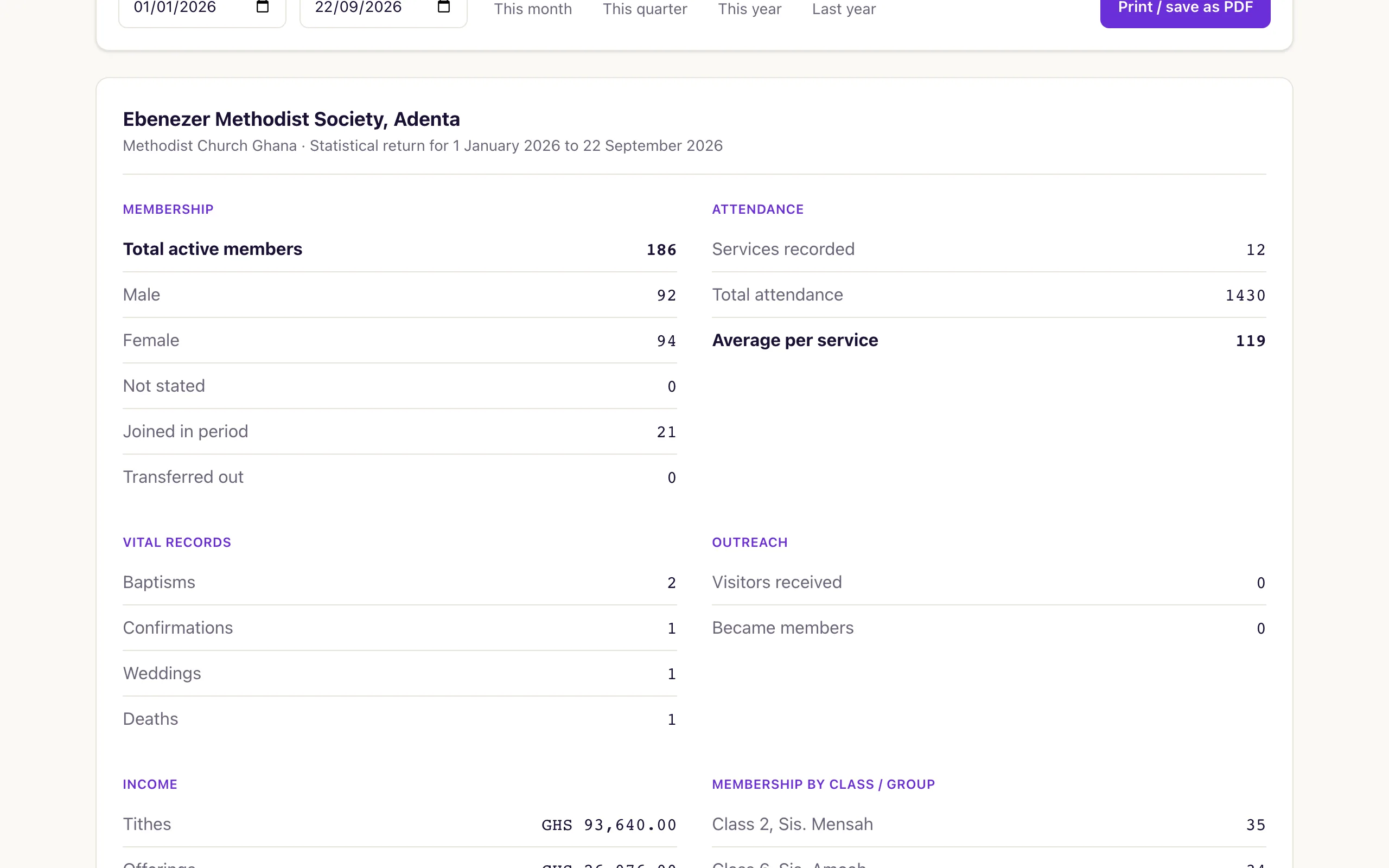
If your return took more than an hour this quarter, the time went into reconciling records that should have been one record. That is worth fixing once rather than paying for every quarter.
Questions people ask
- What is a church statistical return?
- A periodic report, usually quarterly, from a congregation to the level above it: circuit, district, presbytery or diocese. It states membership, attendance, baptisms, marriages, deaths, transfers and income for the period so the denomination can see the state of each church.
- Who prepares the statistical return?
- Usually the society or church secretary, with attendance from the class leaders and income from the treasurer. The minister signs it before it goes up.
- How often is it submitted?
- Quarterly in most Ghanaian denominations, including the Methodist Church Ghana, with an annual summary at conference or synod. Some districts also ask for a monthly attendance figure.
- Does mobile money giving count?
- Yes. Tithes and offerings received by MTN MoMo, Telecel Cash or AirtelTigo Money are income for the period exactly as cash is. They are often left out because they never pass through the offering book.
- Can software produce the return automatically?
- Yes, if the register, attendance and giving are kept in it. Church management software built for Ghanaian denominations, including Fold, produces the return for any period from records already entered.
Sources
Part of Running a church in Ghana: the complete guide, which covers the register, attendance, giving, the statistical return and more, each with free templates.