How to set up mobile money giving for your church
By Emmanuel Akyeam, Founder of Fold
In short
A church in Ghana can take mobile money giving in three proper ways: a merchant account registered to the church with MTN, Telecel or AirtelTigo, a payment processor such as Paystack or Hubtel that settles to the church's own mobile money or bank account, or church software with giving built in that records each gift against the member. A MoMo number on the projector works but puts church money in a personal wallet with no record of who gave. Paystack charges 1.95 percent on mobile money in Ghana, so a GHS 100 tithe reaches the church as GHS 98.05, and on MTN the member must type back a code sent by text before anything is paid.
Ghanaians moved GHS 4.54 trillion through mobile money in 2025, half again as much as the year before, across 26.7 million active accounts and nearly half a million agents. A church that does not take mobile money is asking a congregation that pays for everything else on a handset to bring cash for one thing. Most churches know this, and most started the same way: a MoMo number on the projector and a request from the pulpit. It works, in the sense that money arrives. It also arrives on somebody's phone with no record of who sent it or what it was for, and that is where the trouble starts.
Why the number on the projector is a problem
- The money lands in a personal wallet, usually the treasurer's or the pastor's. Separating it from their own money is a weekly manual job and a trust problem waiting to happen.
- Nobody knows who gave. A transfer carries a name and a number, but matching thirty of them to the register on a Sunday evening does not get done, so the giving is recorded as anonymous or not at all.
- It is invisible to the return. Money that never passed through the offering book is money the quarterly return does not know about.
- It depends on one person and one phone.
Three ways to do it properly
A merchant mobile money account
MTN, Telecel and AirtelTigo each offer a merchant account registered to the church, separate from any personal wallet. Members pay to a short code, the money sits in an account the church controls, and a statement comes with it. This fixes the personal wallet problem and gives a record of every transaction. It does not tell you which member gave unless they add a reference, and it does not connect to your register. Setting one up needs the church's registration documents and a visit to the network.
A payment processor
A payment processor such as Paystack or Hubtel sits between the member and the church. The member pays through it, it takes a fee, and the balance settles to an account the church names, which can be a mobile money number or a bank account. Every payment carries a reference, so the church can tell who paid what. Paystack charges 1.95 percent on mobile money in Ghana, so a GHS 100 tithe reaches the church as GHS 98.05. Once the church's registration is verified, the processor handles all three networks, so a member on Telecel and one on MTN pay the same way.
Church software with giving built in
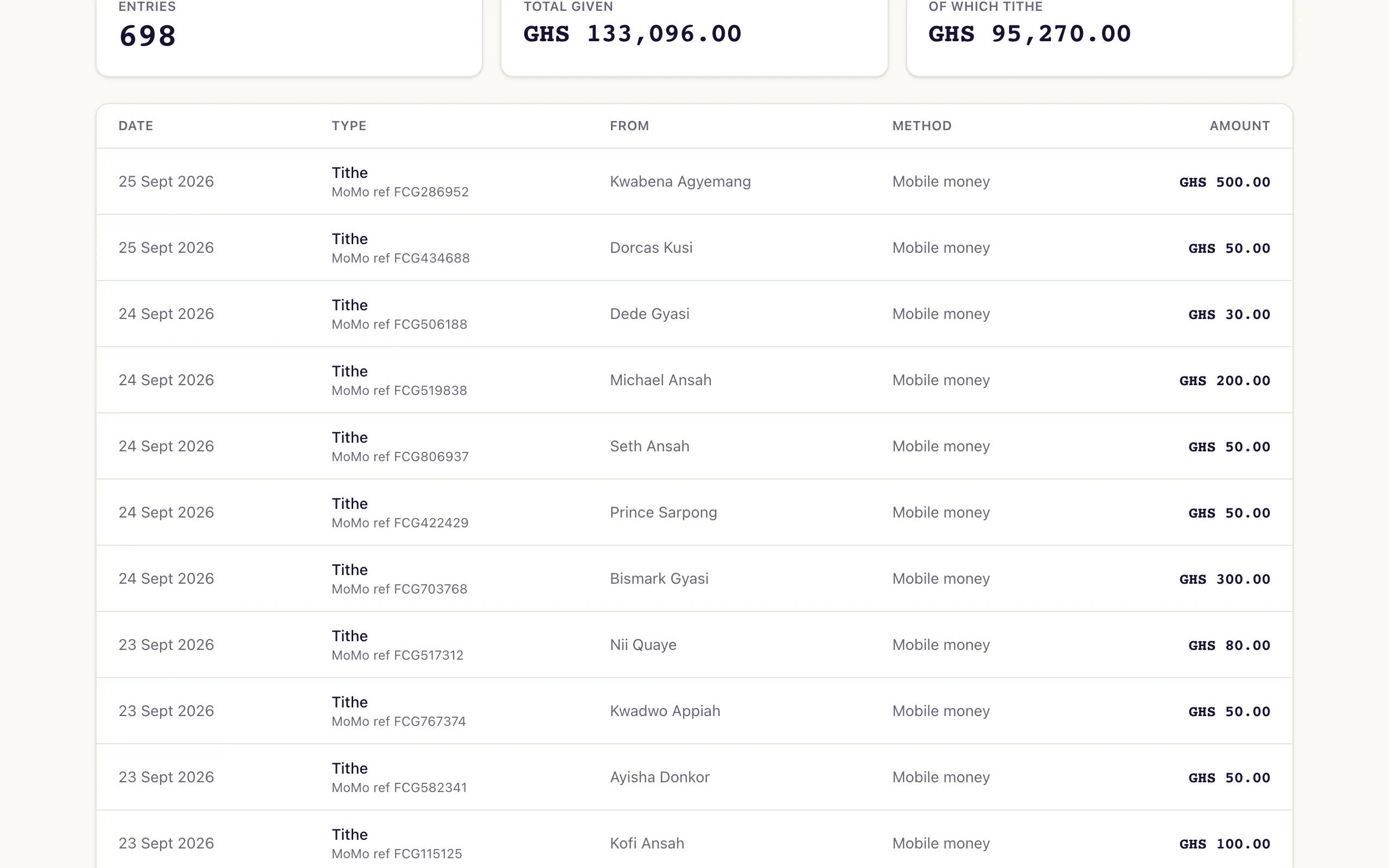
Church management software that includes giving does the processor step for you and connects each payment to the register: the gift is recorded against the member and the fund the moment it succeeds, and appears in the quarterly return without anybody copying it across. Underneath it is usually a processor, so the fee is the processor's fee. The question to ask any vendor is not what percentage they take but whether the money ever passes through their account at all. If it does, they are holding your church's tithes, which is a different relationship from selling you software.
| Number on the projector | Merchant account | Payment processor | Church software with giving | |
|---|---|---|---|---|
| Where the money lands | A personal wallet | An account the church controls | The church's mobile money or bank account | The church's account, through a processor |
| Who gave is known | Only by matching transfers by hand | Only if the member adds a reference | Yes, every payment carries a reference | Yes, recorded against the member and fund |
| Connects to the register | No | No | No | Yes |
| In the quarterly return | Often missing | After a monthly statement is copied in | After its dashboard total is copied in | Already, from the moment the gift succeeds |
| Cost | - | - | Paystack: 1.95 percent on mobile money | The processor's fee underneath |
What your members will actually see
Nobody explains this in advance. When a member pays through a processor on MTN, they do not get a prompt to approve. They get a text: Enter code 098055 to pay GHS 50.00 to <the merchant name>. Somebody has to type that code back, and until it goes in nothing has been paid. After a few minutes the attempt expires.
Two things follow. The person collecting needs somewhere to enter the code and needs to know to ask for it, or the payment sits unfinished while the member believes they have given. And the merchant name on that text is the processor account's registered name, not necessarily your church's. Whoever sets this up should tell you what that name will be, and a thank you text from the church itself a few minutes later does a great deal to close the gap.
What to tell the congregation
- Say it from the pulpit once, properly: which method, what the text message will say, and that a thank you will follow from the church.
- Keep cash exactly as it was. Recording a cash gift is one form, and treating cash as the awkward option loses the people who give most.
- Name what the money is for when you ask. A member paying tithe wants it recorded as tithe.
- Put it on the notice board and in the bulletin, because half the congregation was talking during the announcement.
- Acknowledge it. Money that arrives on a handset and is never thanked is money that stops arriving.
Reconciling it with the books
Whichever method you use, the treasurer needs the mobile money total beside the cash total or the return is wrong. With a merchant account that means downloading a statement monthly. With a processor it means the same from its dashboard. With software it means nothing, because the gift was recorded when it succeeded. That difference is the whole argument for the third option, and it is worth more than the fee. What mobile money actually costs a church goes through the fees line by line.
Questions people ask
- How do churches in Ghana collect tithes by mobile money?
- Three ways: a personal or merchant MoMo number members transfer to, a payment processor such as Paystack or Hubtel that settles to the church's account, or church software with giving built in that records each gift against the member. Most start with a number on the projector and move on when reconciling it becomes a burden.
- What does Paystack charge for mobile money in Ghana?
- 1.95 percent per mobile money transaction, so a GHS 100 gift settles as GHS 98.05. There is no monthly fee on a standard account.
- Does the member get a prompt to approve the payment?
- On MTN in Ghana, usually not. The member receives a text containing a code, and the code has to be entered to complete the payment. Nothing is paid until it is, and the attempt expires after a few minutes.
- Can a church use its own MoMo number for offerings?
- Yes, and many do, but a personal wallet mixes church money with somebody's own, records nobody, and is invisible to the offering book. A merchant account is the minimum improvement; a processor or church software adds the record of who gave what.
Sources
Part of Running a church in Ghana: the complete guide, which covers the register, attendance, giving, the statistical return and more, each with free templates.