How to produce your statistical return without a spreadsheet
By Emmanuel Akyeam, Founder of Fold
In short
To produce a statistical return without a spreadsheet, record each fact once, at the moment it happens, in one place that can be counted later: attendance on the Sunday, giving when it is counted, a baptism the week it happens. The return then becomes a question about a period rather than an evening of reconciling the register, the Sunday counts, the minister's notes and the cash book. Make sure average attendance is calculated against services actually held, not the number of Sundays in the period.
Ask a church secretary what the worst evening of the quarter is and you will usually get the same answer. The step by step guide to preparing the return is the practical companion to this piece. It is the one spent assembling the return: counting the register by hand, adding up the cash book, working out an average attendance from a column of Sunday figures, and chasing the class leaders who have not sent theirs in.
The work is not hard. It is that the same facts are recorded in four different places, by four different people, in four different formats, and nothing adds them up for you.
Why it takes a whole evening
A return usually asks for four kinds of figure, and each one comes from somewhere else:
- Membership, from the register, which is a book or a spreadsheet that may not reflect who has actually left
- Attendance, from the Sunday counts, which have to be averaged across the period
- Vital records, baptisms and confirmations, often only in the minister's own notes
- Income, from the cash book, split by tithe, offering and anything raised for a project
None of those is difficult on its own. The evening disappears into reconciling them: deciding whether the person who transferred out in July still counts, finding the Sunday somebody forgot to write down, and adding a column of figures twice because the first total did not look right.
The fix is not a better spreadsheet
The instinct is to build a smarter spreadsheet, and it does help for a while. But a spreadsheet still depends on somebody entering the same fact twice, once when it happens and again when the return is due, and that second entry is where the evening goes and where the mistakes creep in.
The change that actually matters is recording each fact once, at the moment it happens, in a form that can be counted later. Attendance recorded on the Sunday. Giving recorded when it is counted. A baptism recorded the week it happens rather than remembered in October.
| Figure | Where it lives now | Recorded once, when |
|---|---|---|
| Membership | A register that may not show who has left | Somebody joins, transfers out or leaves |
| Attendance | A column of Sunday counts, averaged by hand | On the Sunday |
| Baptisms and confirmations | Often only the minister's own notes | The week it happens |
| Income | The cash book, split by tithe, offering and project | When it is counted |
What that looks like in practice
If the register, the attendance and the giving all live in the same place, the return stops being a task and becomes a question you ask: what were the figures between January and September? Membership by class, the average across the services you actually held, baptisms and confirmations in the period, and income split by type.
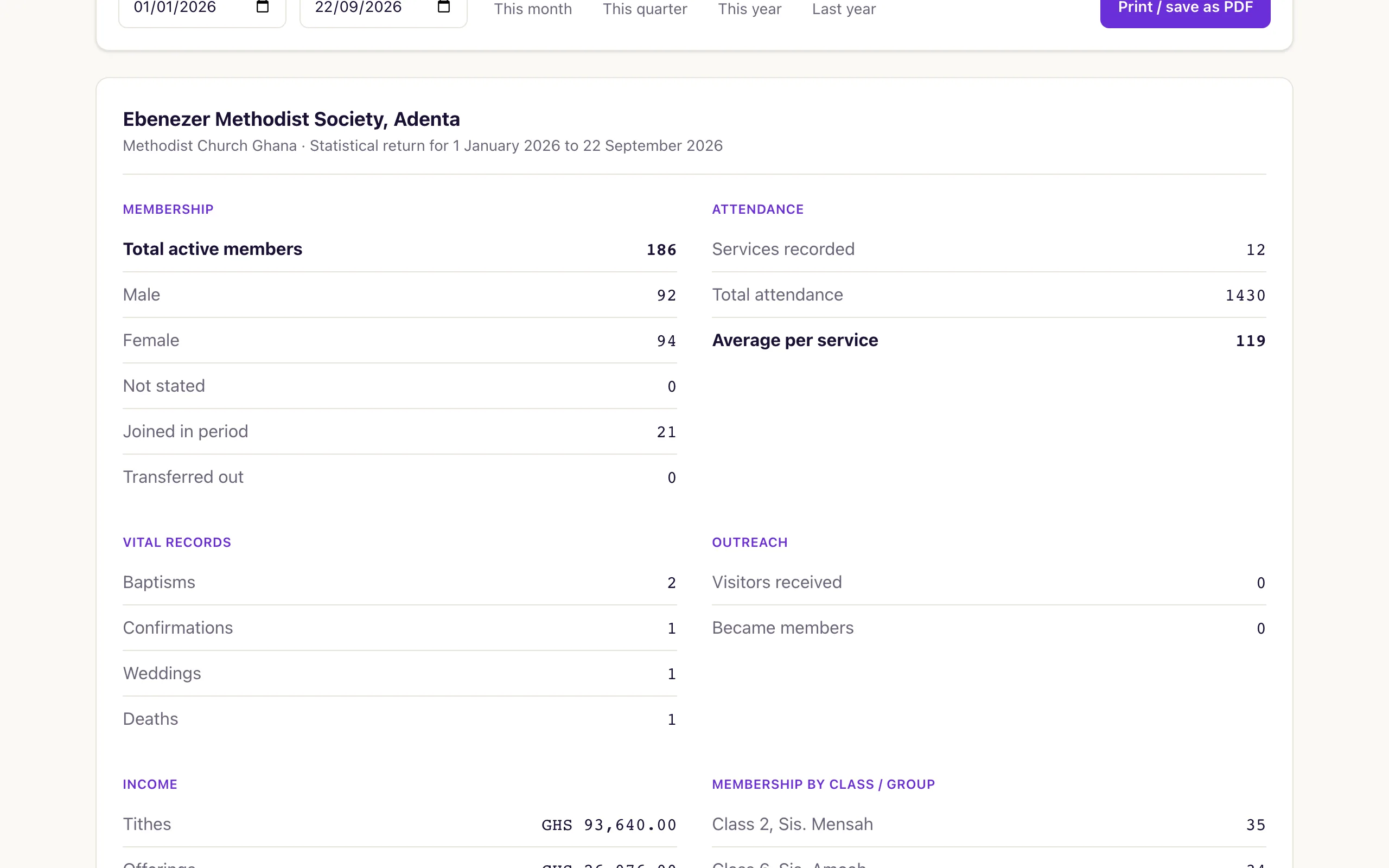
One thing worth insisting on: the average should be calculated against services actually held, not against the number of Sundays in the period. A church that did not meet on two Sundays has a different average from one that did, and a system that divides by the calendar quietly understates every church that lost a week to a funeral or a storm.
Record each fact once, when it happens. Everything else is arithmetic, and arithmetic is what a computer is for.
Where to start if you are still on paper
Do not try to move ten years of records. Start with the people who come every week, this Sunday's head count, and this month's giving. One quarter later you will have a return that assembles itself, and you can add the history at your own pace, or never.
Part of Running a church in Ghana: the complete guide, which covers the register, attendance, giving, the statistical return and more, each with free templates.